
武芸流派辞典
Bugei Ryūha Jiten
- Author:
- Watatani Kiyoshi, Yamada Tadashi (綿谷 雪, 山田 忠史)
- Category:
- Martial Arts
- Collection:
- Robert C. Gruzanski Collection
Description
The 1963 Bugei Ryūha Jiten (Limited Edition, Copy No. 502)
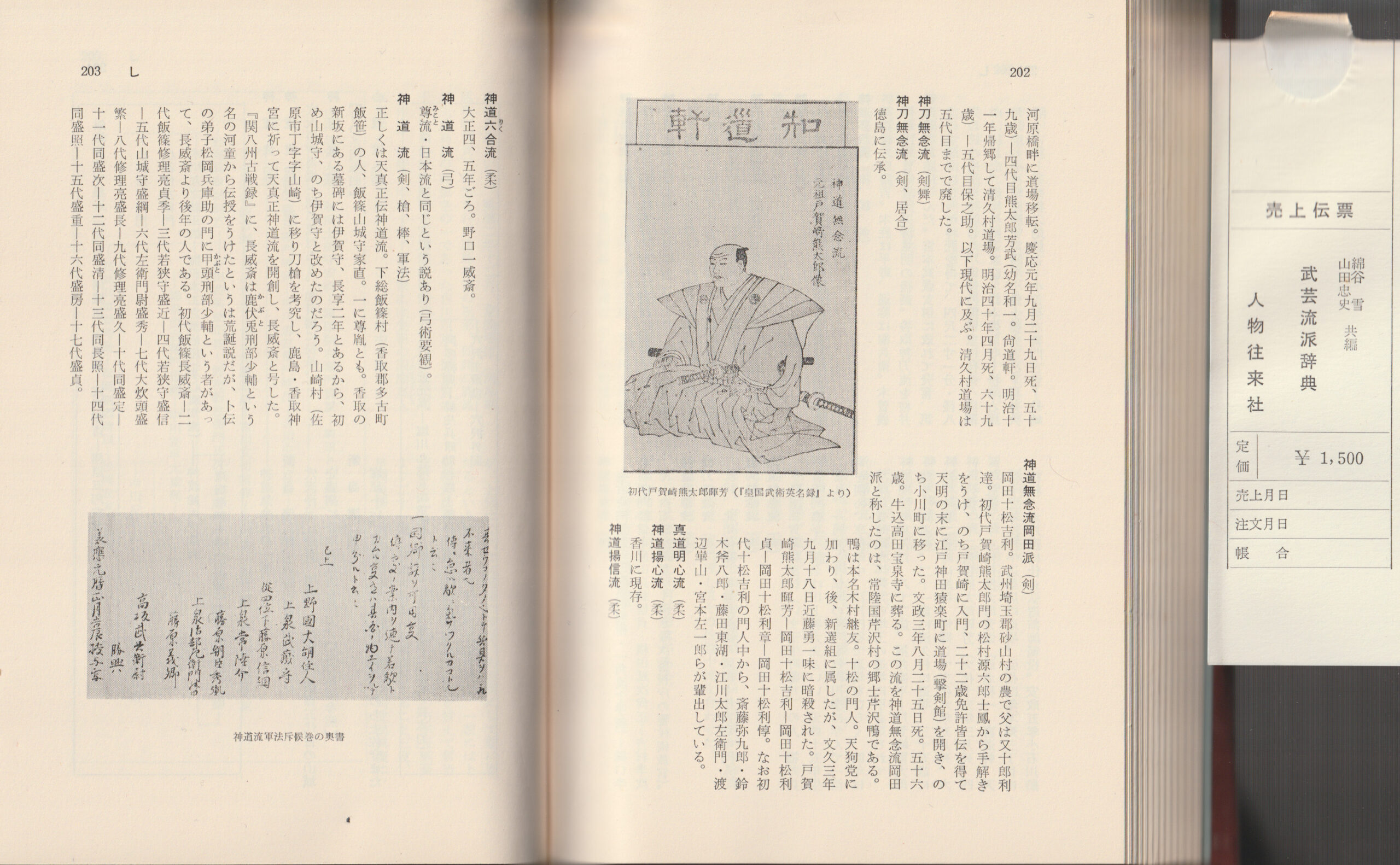
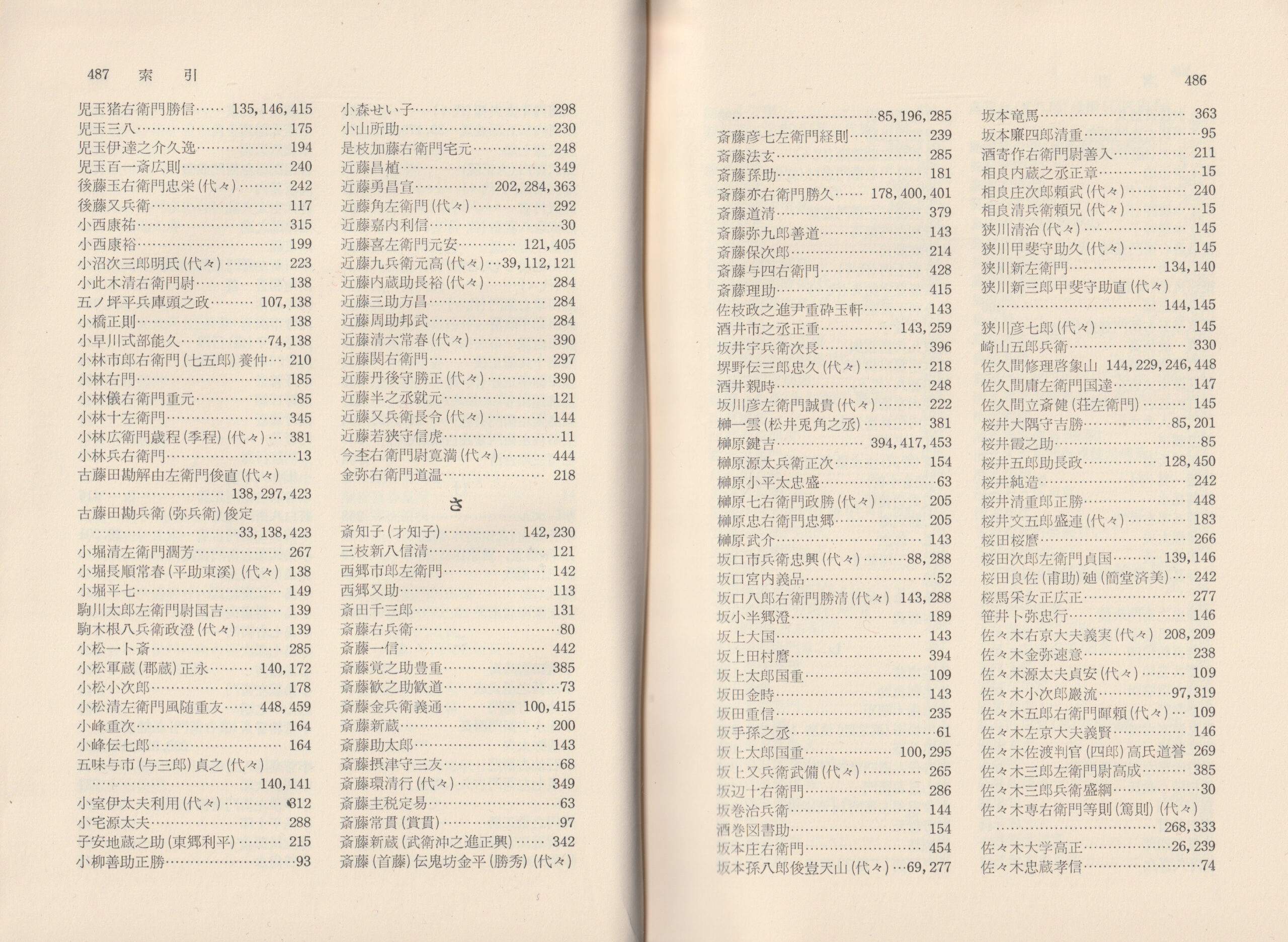
The Bugei Ryūha Jiten (武芸流派辞典) is a legendary milestone in traditional Japanese martial arts historiography. Published on March 1, 1963, by Jinbutsu Ōraisha, this first-edition volume represents the raw, unedited foundation of classical samurai and ninja lineage cataloging. Unlike mass-market history books, it was compiled as a rigorous academic census to preserve ancient provincial warfare systems (koryū bujutsu) before they faded from memory in post-war Japan.
Spanning 508 pages in an A5 hardcover format, the directory details the complex lineages, historical disputes, and transmission scrolls of traditional schools specializing in swordsmanship (kenjutsu), spear fighting (sōjutsu), grappling (jūjutsu), and military strategy (heihō).
Rare and Unusual Facts About the Volume
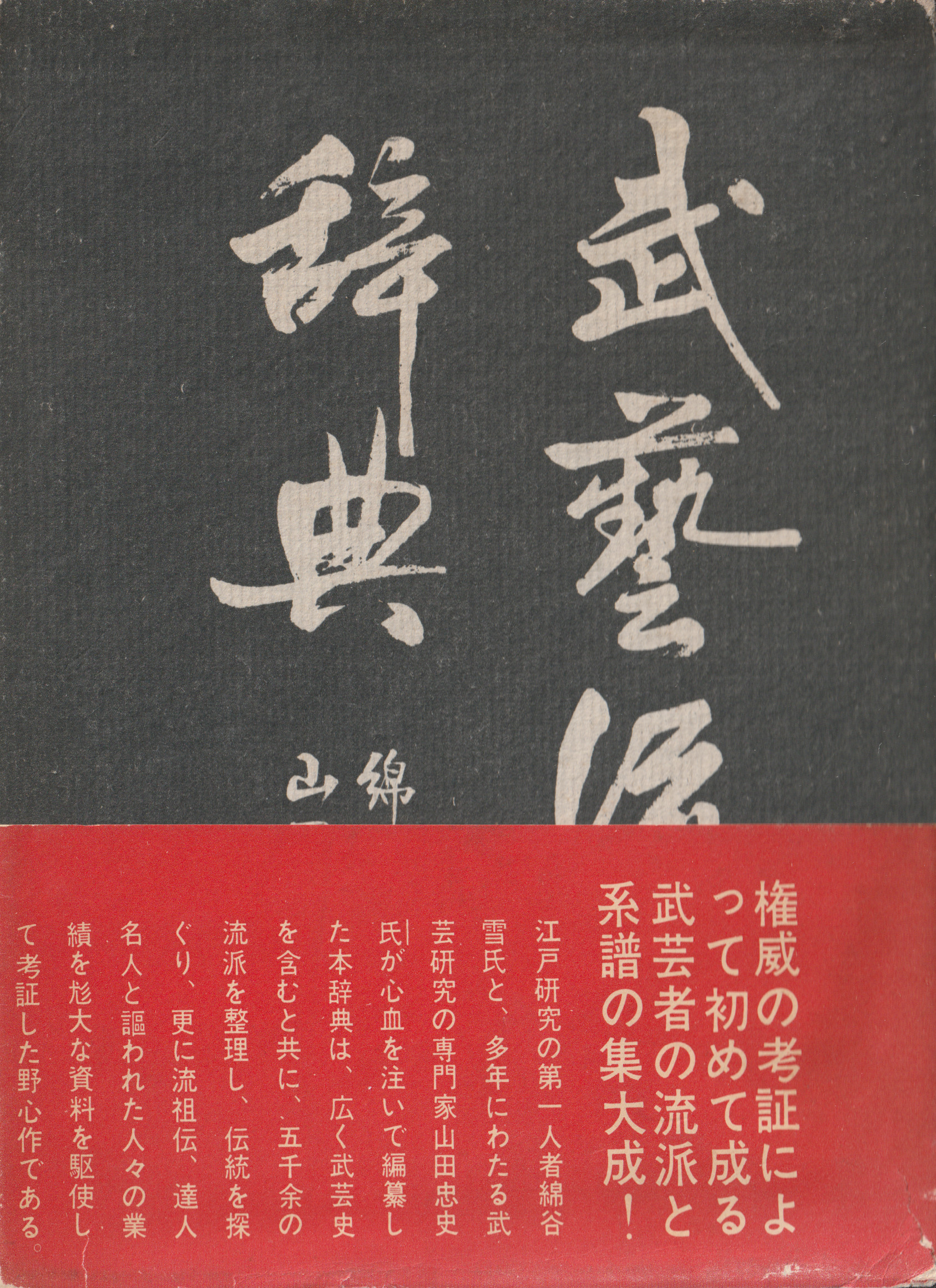
- The Miraculous Red Obi (Promotional Band): Finding a 1963 book with its original paper Obi (帯) intact is a massive rarity. These fragile, paper-thin promotional bands were treated like modern shrink-wrap; they were almost instantly torn, discarded by bookstore cashiers, or thrown away by readers. Having a pristine, unfaded survival of this red band—which proudly proclaims the book as the world’s first authoritative compilation of martial arts lineages—drastically elevates its condition grade and collector demand.
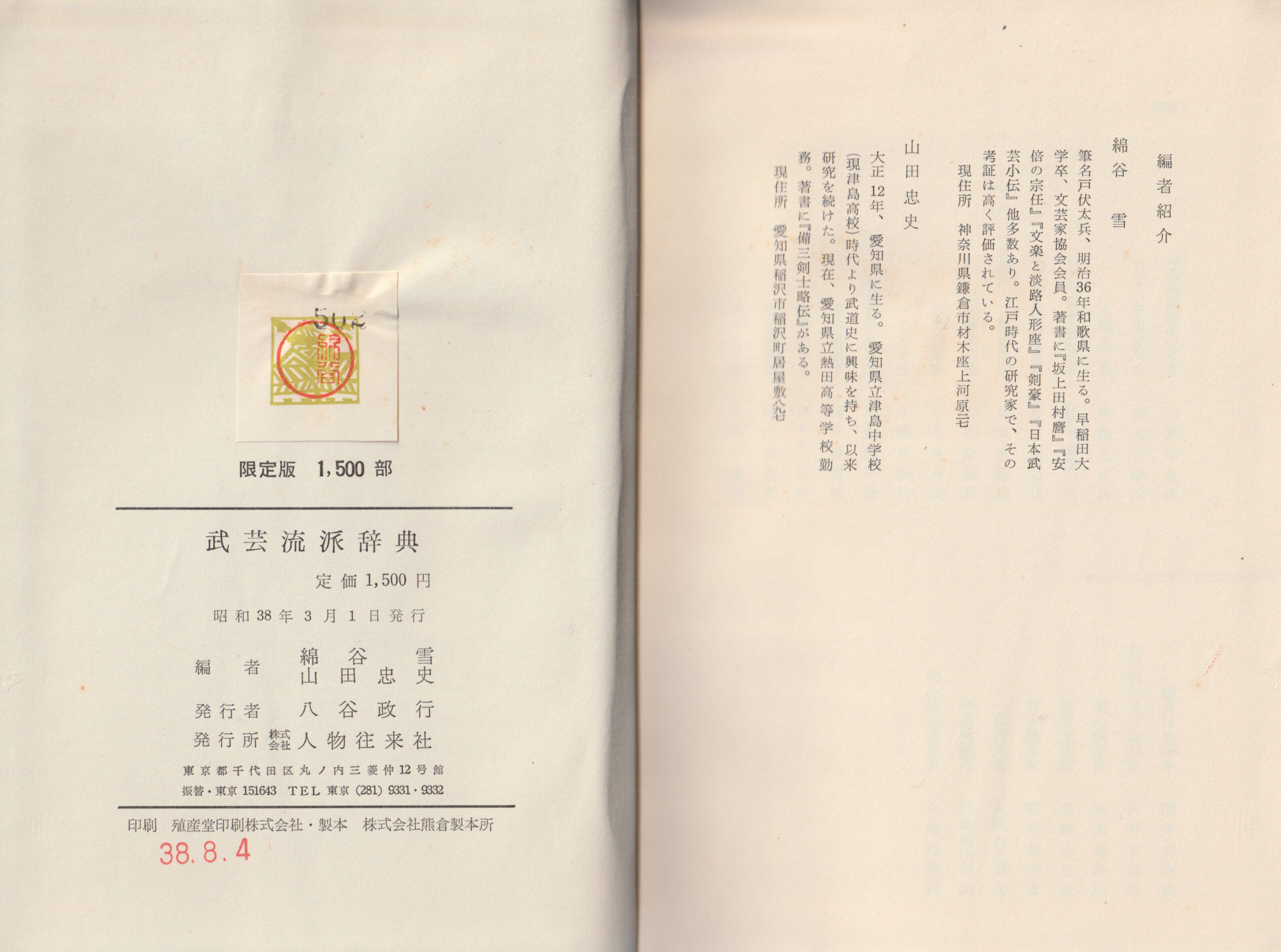
- The 1,500 Symmetry: This book is famous among elite Japanese antiquarian book collectors for a unique numeric coincidence: the print run was strictly restricted to 1,500 copies worldwide, and it originally retailed for exactly 1,500 Yen in 1963.
- The Counterfeit-Proof Registry (Copy No. 502): Rather than printing serial numbers directly onto the page machine-style, the publisher utilized a premium authentication method. Copy No. 502 is hand-stamped onto an independent piece of textured, fibrous traditional Japanese paper (washi) tipped-in directly onto the leaf, complete with a large, crimson corporate seal of Jinbutsu Ōraisha. This labor-intensive technique was stolen from classical currency printing to prevent bootleg editions.
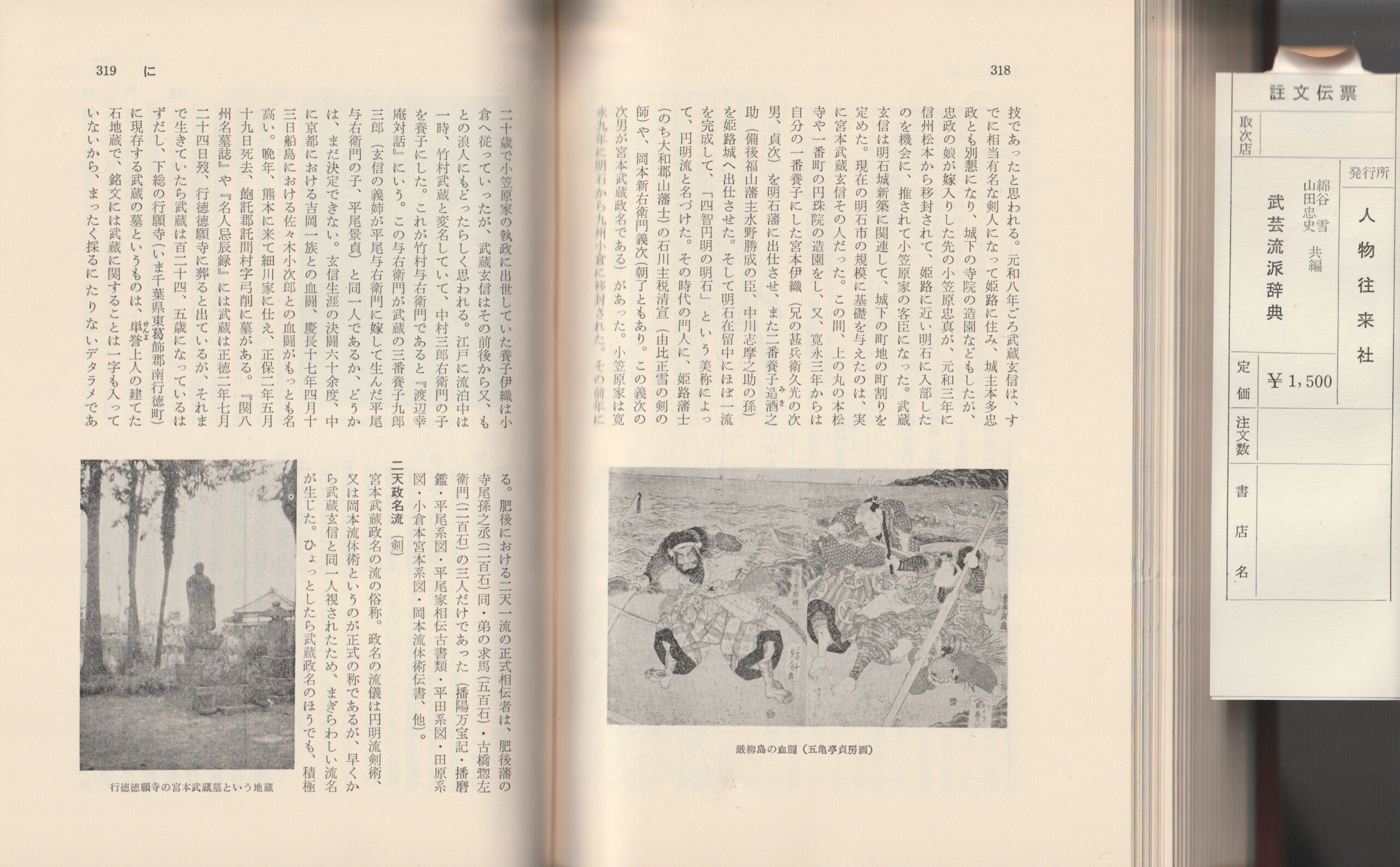
- The Time-Capsule Ghost Slips: Tucked right into the volume is the ultimate “holy grail” pairing for a print archivist: the original, dual-part loose publisher slips—the Order Slip (注文伝票) and the Sales Slip (売上伝票). Because these fragile cards were temporary retail tracking tools designed to be torn down their perforated line and thrown into trash bins at the cash register, their presence proves this specific book bypassed standard commercial retail circulation entirely. It likely spent over six decades untouched inside a distributor’s back-stock crate.
- The Ninja Master Sourcing: To map out authentic shadow arts (ninjutsu) lineages, the authors bypassed folklore and directly collaborated with Fujita Seiko, the legendary martial artist recognized as the 14th Grandmaster of Kōga-ryū Ninjutsu. Fujita opened his private family scrolls to the authors just before his death, making this book one of the earliest mainstream academic texts to legitimize ninja lineages alongside prestigious samurai systems.
Unusual Facts About the Authors
- The Satirist’s Double Life: Author Watatani Kiyoshi (1903–1983) lived a striking double life in the Japanese literary scene. Before transforming into a strict, zero-nonsense compiler of martial arts encyclopedias, he was a famous cultural satirist and mainstream novelist across Japan writing under the colorful pen name Tobushi Tahei (戸伏太兵).
- Yamada Tadashi’s Century of Research: Co-editor Yamada Tadashi (1923–2023) was an expert in transcribing complex, handwritten Edo-period scrolls (densho). He possessed an incredible centenarian lifespan, living past his 100th year. Even into his late 90s, he remained a sharp, primary resource, personally answering letters from global historians tracking down obscure, forgotten family sword techniques.
- Academic Warfare Against Legends: The authors were fiercely dedicated to separating historical fact from martial folklore. Throughout pages like 318 and 319 (covering Miyamoto Musashi), they actively challenge regional tall tales, calling out forged family genealogies (bugen) created in the late Edo period and explicitly branding certain village gravestone inscriptions as “complete fabrications” (detarame).
Deep-Dive: Text Translations of the Red Obi (Front & Back)
The fragile red promotional paper band (Obi – 帯) wrapped this 1963 Bugei Ryūha Jiten acts as a historical time capsule. It contains dense marketing copy, a manifesto of their research methods, and a registry of the elite martial arts grandmasters who opened their private family vaults for this project.
Below is the complete text breakdown and translation of both sides of the Obi:
The Front Side: The Publisher’s Manifesto
The front panel uses bold typography to announce the groundbreaking nature of the book to the 1963 Japanese public:
- Main Banner (Left): 「日本初の科学的メスによる武芸流派の集大成!」
Translation: “Japan’s very first compilation of martial arts schools achieved through an authoritative, scientific scalpel!” - The Problem It Solved (Middle Paragraph): The text explains that prior to 1963, Japanese martial arts history was plagued by myths, exaggerations, and oral fairy tales. It states: “For centuries, school lineages were shrouded in secrecy or distorted by folklore. Through rigorous historical cross-referencing of surviving scrolls, this volume brings objective truth to light for the first time.”
- The Author Profiles (Right Column): 「綿谷雪 (江戸期風俗研究家) / 山田忠史 (武道史研究家) 編」
Translation: “Compiled by Watatani Kiyoshi (Researcher of Edo Period Cultural Customs) & Yamada Tadashi (Researcher of Martial Arts History).” It explicitly frames them as objective academic historians rather than mere sports instructors.
The Back Side: The Grandmaster Registry
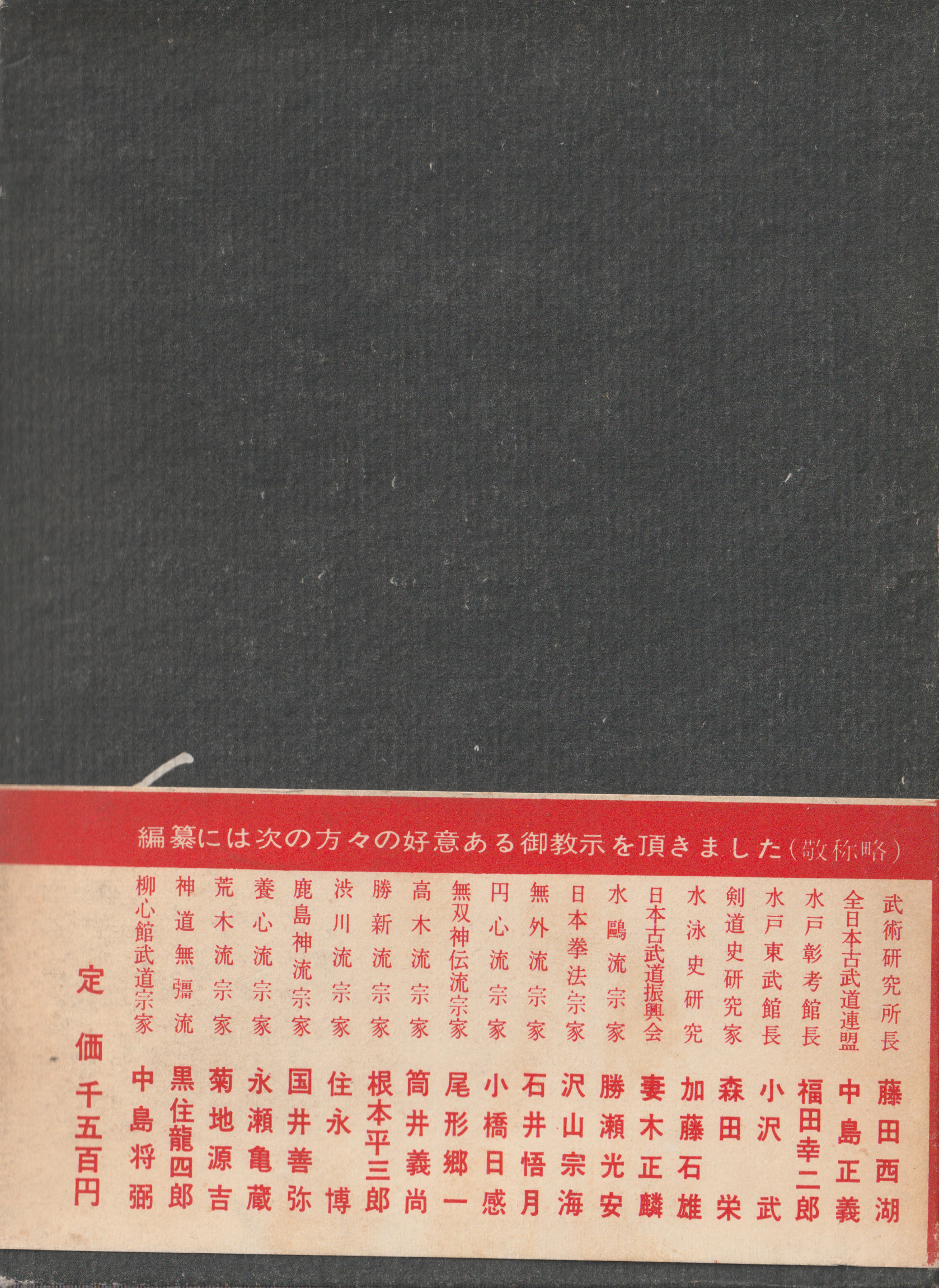
The reverse side of the red band is highly valuable to modern martial arts practitioners (Koryū stylists). It acts as a formal “Thank You” list, cataloging the specific style heads (Sōke) and master collectors who provided the original handwritten scrolls (densho) for transcription.
The text begins: 「編纂には次の方々の好意ある御教示を頂きました (敬称略)」(“For this compilation, we received kind guidance and primary source instruction from the following individuals [Titles omitted for brevity]:”)
Key historical figures listed across the columns include:
The Price Tag (Left Edge): 「定価 千五百円」 (“Fixed Price: 1,500 Yen”), creating the famous 1,500 Yen / 1,500 copies collector symmetry.
藤田西湖 (Fujita Seiko): The legendary martial artist and historical researcher recognized as the 14th Grandmaster of Kōga-ryū Ninjutsu. His inclusion here proves the authors had direct access to authentic ninja scroll repositories before his death.
根本平三郎 (Nemoto Heizabō): A highly revered master of Kashima Shintō-ryū, one of Japan’s oldest surviving traditional swordsmanship systems.
黒住龍四郎 (Kurozumi Ryūshirō): A legendary authority representing the Shintō Musō-ryū staff-fighting (jōdō) tradition.
中島将弼 (Nakajima Masasuke): Grandmaster of Gōshin-ryū martial systems, known for preserving classical unarmed defense and close-quarters combat.
永井善弥 (Nagai Zenya): Representing the ancient and secretive Shingetsu Musō-ryū tradition.
Edition details
- Published:
- 03/01/1963
- Publisher:
- Jinbutsu Ōraisha
- Edition:
-
- • Title (Romaji): Bugei Ryūha Jiten
- • Title (English Translation): Dictionary of Martial Arts Schools
- • Editors: 綿谷雪 (Watatani Kiyoshi) & 山田忠史 (Yamada Tadashi)
- • Content Edition: 1963 Original First Edition (初版)
- • Warehouse Processing Date: August 4, 1963 (Stamped as 38. 8. 4)
- • Production Status: Limited collector's edition strictly restricted to 1,500 copies worldwide
- • Individual Registry Number: No. 502 of 1,500
- • Total Pages: 508 pages
- • Original Retail Price: ¥1,500 Yen
- • Included Rare Ephemera: Original red promotional paper wrapper band (Obi)
- • Tracking Inserts: Matching intact two-part publisher tracking slips (Order Slip / Sales Slip), and the authentic tipped-in washi paper serial plate bearing the official publisher's vermilion seal.
- Condition:
- Good
- Slipcase:
- Yes