Fujita Seiko
藤田 西湖
1899
1966
Fujita Seiko (1899–1966), born Fujita Yūji (藤田勇治) and also associated with the name Isamu (勇), was an influential Japanese martial arts researcher, author, collector, and public demonstrator. Under the name Fujita Seiko (藤田西湖), he identified himself as the 14th-generation successor of Kōga-ryū ninjutsu, a designation by which he was widely known during his lifetime. Fujita later identified Asakusa, Tokyo, as his birthplace; however, Professor Yūji Yamada's examination of Fujita's earliest contemporary newspaper profiles found that they consistently identified Izu Ōshima as his place of birth, making Izu Ōshima the more likely historical birthplace. Contemporary sources give his birth date as August 13, 1899.
Following a turbulent youth and periods of study at several universities, Fujita was reported to have graduated from Nihon University in 1919. By the early 1920s, he had attracted public attention through spiritual and physical demonstrations and increasingly presented ninjutsu as a practical discipline grounded in intelligence gathering, observation, endurance, deception, physical training, and adaptability rather than supernatural powers. He subsequently became a prolific martial arts author, researcher, and collector, writing extensively on ninjutsu, classical martial arts, physical conditioning, and related subjects.
Fujita also taught ninjutsu and related subjects in connection with the Army Nakano School during its early years. Surviving records document at least part of this instruction, while Fujita's own contemporary accounts describe a substantially broader involvement with Japanese military and intelligence organizations; the full extent of those activities remains subject to historical verification. In 1957, Fujita explicitly stated that he did not intend to appoint a fifteenth-generation successor, although he hoped that what he regarded as the fundamental spirit of ninjutsu—endurance, adaptability, comprehensive training, and the practical application of knowledge—would be preserved.
Fujita remained active as a martial arts researcher and public figure until his death on January 4, 1966, at age 66. In March 1974, his widow, Kikue Fujita, donated his 3,268-item collection to Odawara City, where it became the Fujita Seiko Bunko. A separate group of several dozen ninjutsu transmission documents was donated to Ueno City, present-day Iga City, and entered the collection associated with what is now the Iga-ryū Ninja Museum.
Biography
Fujita Seiko (藤田西湖): The Definitive Dossier of the 14th-Generation Kōga-ryū Ninjutsu Successor
Subject: Fujita Yūji (Seiko) | Lifespan: 8/13/1899–1/4/1966 | Historical Identity: Known during his lifetime as the 14th-generation successor of Kōga-ryū Ninjutsu
I. THE FORMATIVE YEARS: MARTIAL ARTS, SPIRITUAL PRACTICE, AND PHYSICAL TRAINING (1899–1921)
Fujita Seiko was born on August 13, 1899. In later autobiographical material he identified Asakusa, Tokyo, as his birthplace. However, Professor Yūji Yamada of Mie University, after examining Fujita’s earliest contemporary newspaper profiles, concluded that Izu Ōshima is the more likely historical birthplace. Those early accounts place Fujita on Izu Ōshima before his childhood relocation to Tokyo. Contemporary sources differ on the precise age at which he moved to Tokyo, giving ages eight and eleven.
Born Fujita Yūji (藤田勇治), he later became widely known by the art name Fujita Seiko (藤田西湖). His childhood and youth became the subject of numerous extraordinary stories, some told by Fujita himself and others repeated in contemporary and later profiles. These accounts must be distinguished from independently documented events.
• Academic Foundation: A 1957 contemporary profile states that Fujita graduated from Nihon University’s Department of Religious Studies in 1919. Other contemporary accounts describe a turbulent academic career involving study at Meiji, Chūō, and Waseda universities before his eventual graduation from Nihon University. A December 1951 Asahi Graph profile similarly reported that he had been expelled from Meiji, Chūō, and Waseda before completing his education at Nihon University.
• Childhood Training and the Kōga Tradition: Fujita stated that he received rigorous childhood instruction from his grandfather, Fujita Shintazaemon, also identified in his accounts as Shinnosuke. Within Fujita’s family tradition, his grandfather was regarded as the 13th-generation predecessor of the Kōga lineage that Fujita later claimed to inherit.
Fujita described training beginning in childhood and involving specialized walking, jumping, breathing, endurance, flexibility, observation, martial arts, and physical conditioning. One exercise involved placing cotton or silk floss on the nose and learning to breathe without disturbing it. This particular method appears repeatedly in Fujita’s own accounts and in later profiles describing his childhood training.
Contemporary profiles also repeated a dramatic story in which the young Fujita, reportedly six years old, injured eleven people with a sword while attempting to avenge his elder brother and was subsequently sent to a Buddhist temple. Fujita later described periods spent with Yamabushi mountain ascetics, where he said he practiced austerities, breathing exercises, fire-walking, ritual practices, and other forms of physical and spiritual training. These episodes form an important part of Fujita’s autobiographical narrative, although many details remain difficult to verify independently.
• The Boy Clairvoyant and Spiritual World: Before becoming nationally associated with ninjutsu, Fujita participated extensively in the spiritual, psychic, and mental-training movements popular in late Meiji and Taishō Japan. He later claimed that his childhood training awakened senrigan—clairvoyant perception—and contemporary and later accounts described him as having attracted attention as a youthful “clairvoyant” or “divine child.”
Fujita stated that he encountered prominent figures associated with Japanese psychic and divination movements, including Takashima Kaemon, and developed interests in divination, physiognomy, palmistry, hypnosis, spiritual practices, and mental training.
Later accounts describe a sensational case in which the thirteen-year-old Fujita supposedly assisted a criminal investigation involving an unidentified murder victim and fugitive suspect. Because this episode is primarily preserved through later biographical reporting, it remains an important subject for further examination of the contemporary newspapers said to have covered it.
• The Reijutsu Period: By the beginning of the 1920s, Fujita was publicly active not primarily as a hereditary ninja master but within Japan’s reijutsu and mental-training world. In 1921 he published Iwayuru Shinrei Genshō no Genri oyobi Hōhō and was identified as chairman of the Shūrei Tanshinkai. His approach emphasized that apparently mysterious phenomena could be explained through training, technique, psychology, and physical principles rather than supernatural forces.
This rationalist approach would remain a defining feature of Fujita’s later explanations of ninjutsu.
II. THE SCHOLAR-WARRIOR: THE EMERGENCE OF FUJITA’S NINJUTSU IDENTITY (1922–1936)
During the early 1920s Fujita’s public identity began shifting from spiritual and mental training toward ninjutsu. Research by Shimizu Yutaka, based partly on Fujita’s surviving personal scrapbooks, documents public lectures and demonstrations associated with Kōga-ryū ninjutsu during this period.
A surviving newspaper clipping records a November 11, 1922 public demonstration of Kōga-ryū ninjutsu, while another records a May 31, 1924 lecture on ninjutsu. Professor Yūji Yamada’s examination of contemporary newspapers likewise shows that Fujita was initially introduced as a “researcher of ninjutsu” or “master of ninjutsu” before eventually being publicly identified as the 14th generation of Kōga-ryū.
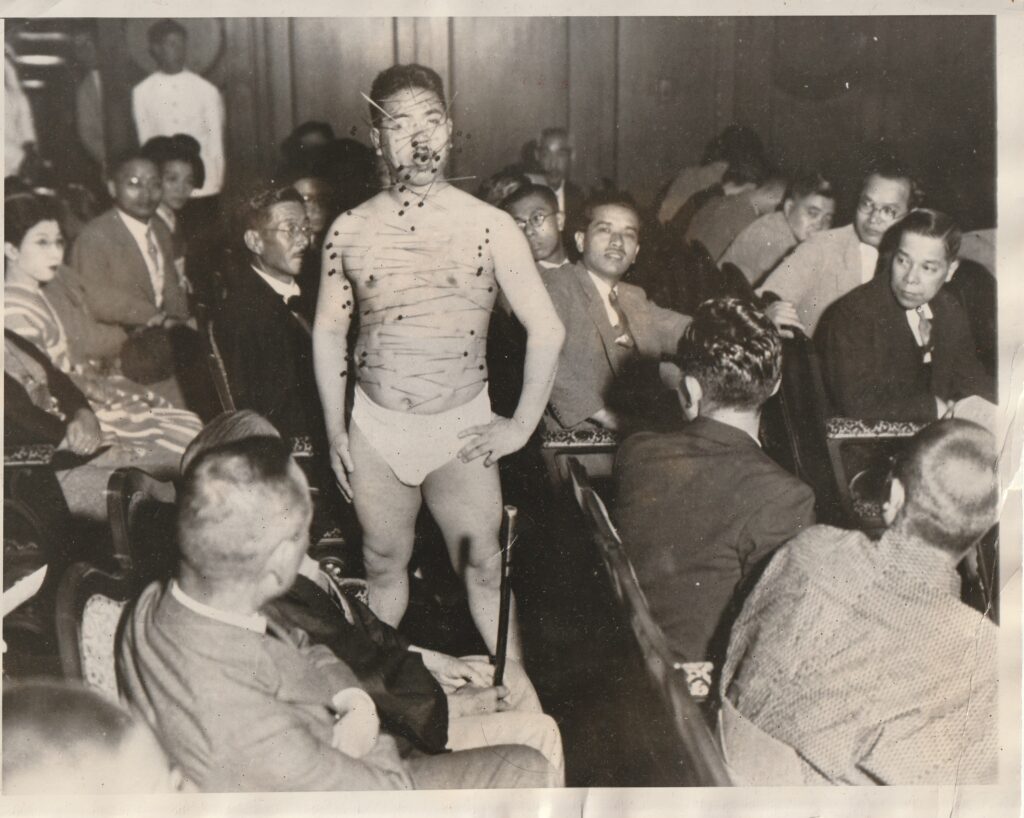
• From Reijutsu to Ninjutsu: Many of the spectacular physical demonstrations later associated with Fujita’s ninjutsu persona—including extreme flexibility, body conditioning, glass-related demonstrations, needle piercing, and other feats—appear to have developed partly from his earlier activities in the spiritual and physical-culture world.
Rather than presenting these feats as supernatural powers, Fujita repeatedly explained them through training, physiology, concentration, psychology, or physical principles. This distinction became central to his public message: ninjutsu, he insisted, was not magic.
• Kunimoto-kyō and Public Performance: Shimizu’s research places Fujita within the flourishing spiritual culture of Taishō-era Japan and reports that he established the religious movement Kunimoto-kyō in 1924. Contemporary descriptions portrayed him as an eccentric and highly theatrical personality who attracted considerable public attention.
As the popular ninjutsu boom expanded, however, Fujita increasingly made ninjutsu the centerpiece of his public identity.
• The Claimed Kōga Lineage: Fujita described his family tradition as descending from Wada Iga-no-Kami and associated it with Kōga. In his January 1952 article Watashi wa Ninjutsu Tsukai, he explicitly identified himself as the 14th successor from Wada Iga-no-Kami and described his house as belonging to the Kōga tradition.
The historical documentation for an unbroken hereditary succession has been questioned by later researchers. Shimizu Yutaka’s 1992 examination of Fujita’s surviving transmission documents identified inconsistencies between the scrolls Fujita described as belonging to his inherited tradition and the ninjutsu documents cataloged elsewhere in Fujita’s writings.
Importantly, Shimizu did not conclude that Fujita fabricated the materials. His analysis instead distinguishes the uncertain documentary basis of Fujita’s hereditary lineage claim from Fujita’s demonstrable importance as a martial artist, researcher, collector, author, and preservationist.
• Research and Writing: Fujita developed an extraordinary interest in martial-arts manuscripts, transmission scrolls, weapons, historical documents, physical training, anatomy, art, and related subjects. He collected and copied martial-arts documents extensively and became known for reproducing manuscripts with remarkable precision.
His most influential prewar ninjutsu publication was:
– 1936: Ninjutsu Hiroku (忍術秘録): Fujita’s major prewar work on ninjutsu, combining historical discussion, traditional teachings, physical training, equipment, techniques, and his interpretation of the art.
Fujita’s writings consistently separated what he regarded as genuine ninjutsu from fictional characters and supernatural entertainment. He rejected the popular image of ninja magically disappearing, transforming themselves, or performing impossible feats, instead describing historical ninjutsu primarily as intelligence gathering, infiltration, observation, deception, survival, psychology, and adaptability.
• Public Demonstrations and Impostors: Fujita’s fame was sufficient to produce imitators. Shimizu documents a 1936 case in which a man named Hoshino Aisaku publicly represented himself as Fujita and attempted to perform under Fujita’s identity before being arrested. Similar impersonation problems reportedly affected other prominent figures associated with the Taishō and early Shōwa ninjutsu boom.
III. THE MILITARY AND INTELLIGENCE YEARS (1930s–1945)
Fujita’s relationship with Japanese military and intelligence organizations requires careful separation between surviving official documentation and the considerably broader career he described in his own writings.
Surviving Imperial Japanese Army records identify Seiko Fujita as an assigned instructor in “Ninjutsu” associated with the Army Nakano School. One surviving instructional schedule records three days of instruction totaling eight hours. This provides firm documentary evidence that Fujita taught there, but it does not by itself establish the full extent of his military activities.
Fujita’s own accounts describe a substantially broader career.
• Fujita’s Account of Intelligence Service: In a first-person article published in Bessatsu Liberal in September 1952, Fujita stated that his connection with military intelligence organizations began in 1921. He claimed that he assisted in the establishment of the Nakano School and taught communications and liaison methods.
Fujita further stated that he taught at the Army Paymasters School and Kempeitai Academy while continuing responsibilities connected with Nakano, and that he maintained close involvement with Kwantung Army special-service organizations in Manchuria.
These statements are important contemporary testimony from Fujita himself, but the complete scope of the activities he described has not yet been independently established through surviving military documentation.
• China, Manchuria, and Mongolia: Fujita described extensive travel and intelligence-related activity on the Asian mainland. In his 1952 account he stated that he had been stationed in Beijing following the outbreak of the Second Sino-Japanese War and described teaching communications, methods relating to poisons and antidotes, breathing techniques, defensive swordsmanship, and throwing techniques.
He also described assassination attempts against him, intelligence operations, disguises, concealed communications, and field experiences in China and Manchuria.
In a 1957 interview with novelist Tsuneo Tomita, Fujita additionally recalled escaping confinement during travels in Mongolia by deliberately dislocating his hand to slip free of handcuffs. Such episodes remain Fujita’s own testimony unless corroborating documentation can be located.
• The Army Nakano School: Fujita later stated that his involvement with Nakano continued until approximately the beginning of 1941 and that his responsibilities included mental education, technical instruction, physical training, and self-defense. He described attempting to adapt what he regarded as his family’s Kōga-ryū ninjutsu to modern applications.
Later scholarship has also associated Fujita with instruction at institutions including the Army Toyama School, Army War College, and other military establishments. Contemporary profiles published during Fujita’s lifetime similarly described him as having lectured on military subjects at Army and Navy institutions. The precise chronology and institutional scope require continued documentary verification.
What can be established is that Fujita’s wartime reputation was not created entirely after his death: both surviving military documentation and multiple statements published during his lifetime associate him with military instruction and intelligence-related activity.
• 1942: Ninjutsu kara Spy-sen e (忍術からスパイ戦へ): Fujita’s wartime publication explicitly connected historical ninjutsu with modern intelligence and espionage. He repeatedly characterized ninjutsu as the intelligence and espionage methods of earlier periods—the historical counterpart of the modern spy.
IV. THE “LAST NINJA” AND THE POSTWAR RESEARCH YEARS (1946–1966)
After the Second World War, Fujita increasingly devoted himself to martial-arts research, collecting, writing, teaching, and public demonstrations.
His postwar activities are unusually well documented through surviving books, manuscripts, photographs, newspaper clippings, and magazine interviews.
• The Postwar Dojo: A July 26, 1950 Asahi Graph feature identified the 52-year-old Fujita as living near Nezu, Tokyo, openly declaring himself the 14th headmaster of Kōga-ryū ninjutsu and instructing approximately twenty disciples.
By December 1951, another Asahi Graph profile described his training hall as the Renshinkan Airinkan Dōjō, popularly called the “Ninjutsu Dōjō.” The article reported approximately 50 regular members and three senior disciples assisting with instruction.
Training described in the article extended beyond ninjutsu and included kenpō, capturing methods, and staff techniques.
• A Rational Interpretation of Ninjutsu: Across interviews published in 1950, 1951, 1952, 1957, and later years, Fujita repeatedly rejected the idea that authentic ninjutsu depended upon supernatural powers.
In the July 1950 Asahi Graph, he stated that ninjutsu consisted of rational, practical arts requiring extensive training of mind and body.
In his January 1952 Liberal article, he explained fire-walking, glass-related demonstrations, hand signs, physical feats, and other apparently mysterious practices through physiology, physics, psychology, concentration, training, or deception.
In the April 1957 Chūgaku Ninen Course interview, Fujita again told Tsuneo Tomita that the fantastic ninja who vanished in smoke or performed magical transformations belonged to popular storytelling. Genuine ninjutsu, he explained, historically existed to infiltrate enemy territory, gather intelligence, and obtain confidential military information.
• Comprehensive Training: Fujita presented ninjutsu as a discipline requiring extraordinary adaptability. In the 1957 interview he explained that training extended far beyond swordsmanship, spear, and jūjutsu:
“We sought to master everything.”
He specifically mentioned dancing, singing, observation, memory, disguise, physical conditioning, reconnaissance, distance estimation, coded communication, and numerous practical skills.
This claim closely parallels his 1952 intelligence article, in which Fujita stated that the requirements of his work had caused him to learn dancing and singing.
• Observation, Memory, and Intelligence: Fujita claimed exceptional powers of observation and memory. He stated that he could memorize books of several hundred pages, reproduce objects after seeing them, estimate weapon measurements using his hands, and reconstruct routes by counting footsteps even when unable to see where he was being taken.
He also described coded communication methods he said he had personally used, including colored and deliberately bent matchsticks indicating identity, time, and direction.
Whether every claimed ability can be independently verified, these interviews demonstrate the qualities Fujita himself considered fundamental to ninjutsu: observation, memory, ingenuity, adaptability, psychological awareness, and complete concentration.
• Physical Demonstrations: Fujita remained famous for spectacular demonstrations of physical conditioning. Contemporary photographs and articles document performances involving glass, needles, restraint escapes, flexibility, body conditioning, and other feats.
A July 1950 Asahi Graph feature photographed demonstrations including rope restraint and escape, glass walking, striking demonstrations, and training exercises. A December 1951 profile continued to present Fujita as an unusual physical and martial-arts instructor.
Such demonstrations made Fujita a media celebrity, but they should be understood as public demonstrations rather than automatically interpreted as evidence of historically transmitted Kōga techniques.
• The Private Manuscript Collection: The April 1957 Chūgaku Ninen Course feature photographed “Secret Ninjutsu Manuscripts from Fujita Seiko’s Private Collection.” Other contemporary and later sources likewise document Fujita’s extensive collection of martial-arts and ninjutsu manuscripts.
Later examination of surviving material reveals Fujita as more than a collector. He personally copied historical documents, annotated manuscripts, compared sources, and attempted to preserve materials that might otherwise have disappeared.
Professor Yūji Yamada has noted the remarkable precision with which Fujita copied historical ninjutsu manuscripts associated with researchers in Iga.
• Japan Martial Arts Research Institute: Fujita established the Japan Martial Arts Research Institute in the postwar period as part of his effort to investigate and preserve traditional Japanese martial arts. Shimizu Yutaka dates its establishment to November 1953.
Fujita increasingly concentrated on serious documentary research into classical martial arts. His surviving collection demonstrates broad interests extending far beyond ninjutsu.
• Martial-Arts Preservation: Fujita believed that classical martial traditions and their documentary records represented cultural assets that should be preserved for future generations.
He collected transmission scrolls and martial-arts texts on a large scale, personally copied rare documents, published technical studies, and attempted to organize information concerning numerous Japanese martial traditions.
Shimizu Yutaka’s 1992 assessment places Fujita among the pioneering figures in the systematic collection, preservation, comparison, and publication of historical Japanese martial-arts materials.
• The 1957 Succession Statement: One of the clearest statements concerning the fate of Fujita’s claimed Kōga lineage appeared in his April 1957 interview with Tsuneo Tomita.
After Fujita explained the extraordinary amount of training he believed ninjutsu required, Tomita asked directly whether he intended to appoint a 15th-generation successor.
Fujita answered:
“No, I do not.”
He then explained that he nevertheless wanted the fundamental spirit of ninjutsu to survive. He defined that spirit as cultivating every aspect of human ability, enduring what human beings are capable of enduring, and making full use of technology and scientific knowledge in order to meet whatever challenges arise.
This statement is reinforced by another 1957 interview in which Fujita observed that almost no one remained who underwent formal training in ninjutsu.
In a later interview he expressed the idea still more directly: there was no need for ninjutsu itself to continue beyond his generation in a postwar society that had renounced war.
Fujita therefore distinguished between perpetuating ninjutsu as an operational hereditary system and preserving what he considered its underlying spirit of endurance, adaptability, discipline, and ingenuity.
• The “Last Ninja”: Fujita became widely known in postwar media as the “last ninja.” The expression reflected both his extraordinary public persona and his own insistence that he did not intend to establish another generation of successors.
The label should not be interpreted as proof that Fujita was literally the final practitioner of every historical ninjutsu tradition. Rather, it became shorthand for his position as one of twentieth-century Japan’s most visible public representatives of ninjutsu and for his declared decision not to continue his own claimed Kōga succession.
• Public Image and Popular Culture: Fujita was frequently frustrated by the fantastic ninja image appearing in fiction, manga, film, and popular entertainment. He distinguished historical intelligence and survival practices from fictional characters such as Sarutobi Sasuke and from supernatural depictions of invisibility and magical transformation.
At the same time, Fujita himself was an accomplished public performer whose unusual physical demonstrations contributed substantially to the fascination surrounding him.
A March 1957 Manga Yomiuri feature provides an especially revealing example: the magazine photographed Fujita and others wearing black shinobi costumes supplied by a theatrical costume shop. The resulting images became part of the modern visual image of the ninja, even though the clothing had been obtained specifically for the magazine presentation.
• International Attention: Fujita’s reputation eventually reached the international press. Newsweek, in its August 3, 1964 issue, included Fujita in the feature “Japan: A Good Cocktail,” accompanied by a photograph by Bernard Krisher.
Late-life profiles continued to emphasize his extraordinary conditioning demonstrations, unusual diet and endurance claims, martial research, and identity as one of Japan’s last public representatives of traditional ninjutsu.
The spectacular numerical claims appearing in such reports should be understood as part of Fujita’s public reputation and contemporary media coverage rather than as independently verified physiological records.
• Definitive Martial-Arts Manuals: Fujita’s later career produced a series of important technical works devoted to classical martial arts and weapons. Among them were studies of jōjutsu, atemi and kappō, shurikenjutsu, and hōjōjutsu.
His 1958 article “Shurikenjutsu Is an Independent Martial Art” (Shurikenjutsu wa Dokuritsu-shita Bujutsu de aru) demonstrates his effort to treat shurikenjutsu as a serious martial discipline rather than a theatrical ninja accessory.
His later major works included:
– Bugei Jūhappan Meishō Jutsukaku Ryakukai (1958)
– Kenpō Gokui Atemi Sakkappō Zukai (1958)
– Zukai Shurikenjutsu (1964)
– Zukai Hōjōjutsu (1965)
The preface to his final hōjōjutsu work emphasized the preservation of classical documentary materials for future researchers.
• Doronron: Fujita’s autobiographical work Doronron was published by Nihon Shūhōsha on August 15, 1958. It remains an important source for Fujita’s own account of his extraordinary life, but autobiographical episodes within it should be distinguished from independently documented events.
V. THE END OF THE LINEAGE: THE FUJITA SEIKO BUNKO
Fujita Seiko died on January 4, 1966, at the age of 66.
By the end of his life he had become an unusual combination of martial artist, author, researcher, collector, illustrator, public performer, and interpreter of ninjutsu. His reputation rested partly upon spectacular stories and demonstrations, but his enduring historical importance also lies in the enormous body of martial-arts material he collected, copied, annotated, studied, and preserved.
His decision concerning succession was not merely a later interpretation of his life. In 1957, when directly asked whether he intended to appoint a 15th-generation successor, Fujita explicitly answered that he did not.
He nevertheless insisted that the spirit of ninjutsu should survive.
For Fujita, the character nin (忍) ultimately represented not simply concealment or infiltration but endurance. His later writings emphasized perseverance, adaptability, complete dedication, and the ability to apply contemporary scientific and technological knowledge to changing circumstances.
This distinction helps explain the apparent paradox of the “last ninja”: Fujita could simultaneously believe that traditional operational ninjutsu should end with his generation while insisting that its underlying spirit remained valuable to future generations.
• The Fujita Seiko Bunko: Following Fujita’s death, his widow, Kikue Fujita, preserved his extensive research collection.
In March 1974, Kikue donated Fujita’s 3,268-item collection as a single donation to Odawara City. This collection became the permanent Fujita Seiko Bunko (藤田西湖文庫) and preserves an extraordinary body of martial-arts books, manuscripts, historical documents, and research materials associated with Fujita’s lifetime of collecting and study.
A separate group of several dozen ninjutsu-related transmission documents, including materials associated with the Bansenshūkai, was donated in April 1974 to Ueno City, present-day Iga City. These materials became associated with the collection now preserved through the Iga-ryū Ninja Museum.
The distinction is important: the 3,268-item Fujita Seiko collection was donated to Odawara; it was not divided between Odawara and Iga.
• Fujita and Iga: Although Fujita publicly identified himself with Kōga-ryū, he maintained significant connections with researchers and historical materials in Iga.
He interacted with researchers including Okimori Naozaburō and Okuse Heishichirō, exchanged information concerning ninjutsu, and copied historical documents associated with their collections.
In 1952 Fujita also participated in the World Children’s Exposition in Ueno City, where a popular ninjutsu exhibition displayed historical materials, equipment, and demonstrations intended to present ninjutsu as something capable of rational rather than supernatural explanation.
These connections help explain why part of the ninjutsu-related documentary material associated with Fujita was ultimately preserved in Iga.
• Historical Assessment: Modern scholarship has made it possible to separate several different aspects of Fujita’s legacy.
His claim to an unbroken hereditary Kōga lineage remains historically difficult to establish from surviving transmission documentation.
His extraordinary autobiographical stories and physical accomplishments likewise vary greatly in their degree of independent corroboration.
His importance as a twentieth-century martial-arts researcher, collector, writer, public figure, and preservationist, however, is considerably better documented.
Fujita’s surviving books, manuscripts, annotations, personal scrapbooks, contemporary interviews, military documentation, photographs, and the thousands of materials preserved in the Fujita Seiko Bunko provide an unusually rich documentary record of a man who stood at the intersection of Taishō spiritual culture, the modern ninjutsu revival, wartime intelligence, classical martial-arts research, and postwar preservation.
The Archival “Holy Grails” (Researcher’s Checklist):
1. Red Cinnabar Hanko: Surviving presentation copies and other materials associated with Fujita bear handwritten inscriptions and personal red seal impressions. Individual seals should be identified from the original impressions rather than assuming that every red seal represents the same name or reading.
2. The Two Principal Archival Holdings: Important portions of Fujita’s surviving research legacy are preserved in two locations:
– The Fujita Seiko Bunko — Odawara: 3,268 items donated by Kikue Fujita to Odawara City in March 1974. The collection preserves Fujita’s extensive martial-arts library and research materials.
– Iga / Ueno Collection: A separate group of several dozen ninjutsu-related transmission documents donated by Fujita’s surviving family in April 1974 and now associated with the historical ninjutsu holdings preserved in Iga.
3. Personal Scrapbooks (№ 484 & 485): Two surviving scrapbooks compiled by Fujita himself preserve newspaper clippings documenting his public activities, lectures, demonstrations, and media coverage across the Taishō and Shōwa periods. Shimizu Yutaka used Fujita’s surviving scrapbook material in his 1992 investigation, including contemporary reports of Fujita’s early ninjutsu lectures and demonstrations.
4. Surviving Ninjutsu Manuscripts: Fujita’s surviving ninjutsu manuscripts and handwritten annotations are especially important for evaluating his relationship with historical ninjutsu literature. Some documents contain Fujita’s own corrections and comments concerning their titles and classification, providing direct evidence of his work as a collector and researcher as well as raising important questions concerning the relationship between historical documents and the lineage tradition he publicly represented.
Note to Researchers: Document reference numbers labeled “№” refer to catalog numbers associated with materials preserved in the Fujita Seiko Bunko (藤田西湖文庫). Individual catalog records should be consulted before attributing specific contents or provenance to an item.
Related Documents
Magazine Fujita Seiko Gekkan Hiden Feature – January 2016 Issue
Magazine Fujita Seiko Shukan Sankei Feature – March 21, 1966 Issue
Magazine Fushigina zasshi Ninjutsu Feature – July 1, 1963 Issue
Magazine Fujita Seiko Shukan Jiken Jitsuwa No. 50 Feature – March 13, 1961 Issue
Magazine Fujita Seiko Jitsuroku Kengo Meishobu-den Feature – July 1, 1958 Issue
Magazine Fujita Seiko Manga Yomiuri Feature – March 1, 1957 Issue
Scroll 1955 Ninjutsu Tiger Scroll (Ninjutsu Tora no Maki) by Fujita Seiko
Magazine Fujita Seiko Bessatsu Liberal Feature – September 1, 1952 Issue