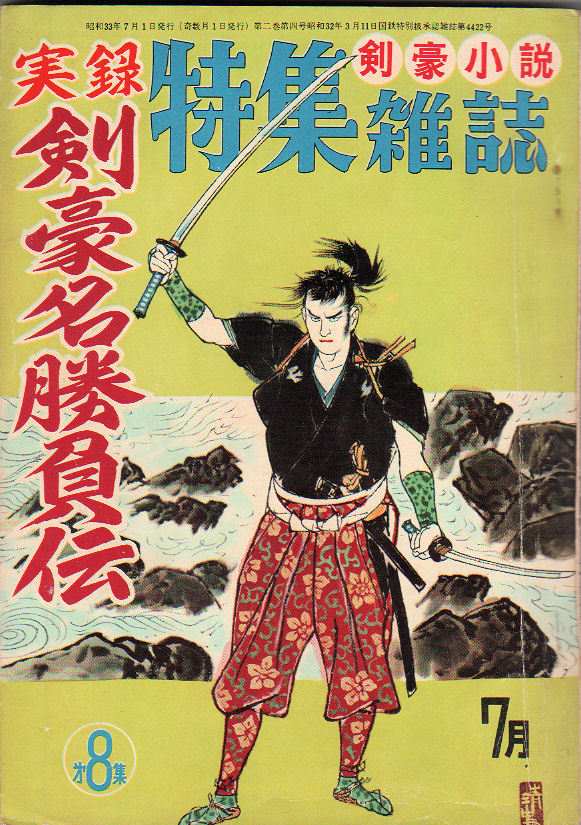
Fujita Seiko Jitsuroku Kengo Meishobu-den Feature – July 1, 1958 Issue
07/01/1958
- Japanese title
- 実録 剣豪名勝負伝
- Publication
- Jitsuroku Kengo Meishobu-den
- Type
- Magazine
- Language
- Japanese
- Collection
- Fujita Seiko Collection
- Authors
- Fujita Seiko
- People
- Fujita Seiko
Notes
This rare 1958 special compilation magazine contains an extensive four-page masterclass essay authored by 14th Generation Kōga-ryū Ninjutsu Headmaster Fujita Seiko (藤田西湖), titled "Shurikenjutsu is an Independent Martial Art" (手裏剣術は独立した武術). Within the text, Fujita provides crucial historical validation for projectile combat, frameworking blade-throwing as an isolated, standalone warrior discipline rather than a basic offshoot of secondary ninjutsu skills. The publication provides highly detailed dimensions, structural design weights, and profiles for traditional throwing spikes utilized across historic factions—specifically detailing the signatures of Negishi-ryū, Shirai-ryū, and Yagyū-ryū lineages. Furthermore, it features original hand-drawn instructional plates illustrating the physical mechanics behind both direct straight-flight paths (直打法) and calculated rotation throws (回転法). Fujita Seiko is credited directly beneath the main article title alongside his formal contemporary title as the Standing Director of the Nihon Kobudo Shinkokai (日本古武道振興会常任理事).
View:
Description
The July 1958 issue of Jitsuroku Kengo Meishobu-den (実録 剣豪名勝負伝 / True Record of Master Swordsmen’s Famous Duels) preserves a rare historical milestone in mid-20th-century martial arts literature: an extensive four-page masterclass essay authored by 14th Generation Kōga-ryū Ninjutsu Headmaster Fujita Seiko (藤田西湖).
Titled “Shurikenjutsu is an Independent Martial Art” (手裏剣術は独立した武術), the feature expands upon page 114 to separate tactical weapon craft from standard pop-culture fiction. Fujita leverages historical combat traditions to frame blade-throwing as an isolated, standalone warrior discipline rather than a basic offshoot of secondary ninjutsu skills.
Ryūha Analysis: The publication provides detailed dimensions, structural design weights, and profiles for traditional throwing spikes utilized across historic factions—specifically detailing the signatures of Negishi-ryū, Shirai-ryū, and Yagyū-ryū lineages.
Throwing Dynamics: Features clean hand-drawn instructional plates illustrating the physical mechanics behind both direct straight-flight paths (直打法) and calculated rotation throws (回転法).
Loading pages…
No document pages available.