
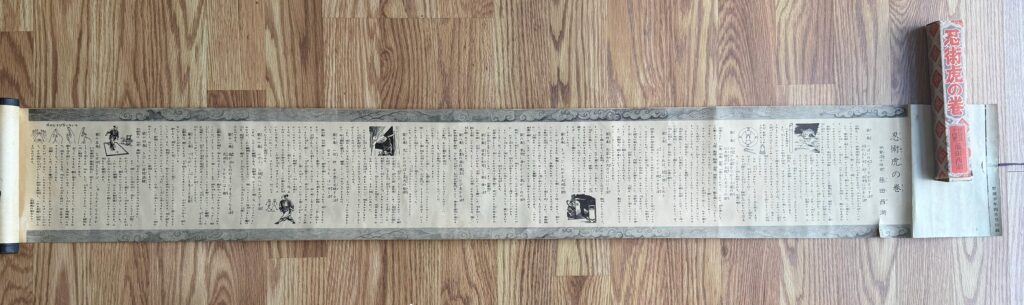
1955 Ninjutsu Tiger Scroll (Ninjutsu Tora no Maki) by Fujita Seiko
04/01/1955
- Japanese title
- 忍術虎の巻 (野球少年四月号付録)
- Publication
- Baseball Boys (Yakyū Shōnen / 野球少年)
- Type
- Scroll
- Language
- Japanese
- Publisher
- Hōbunsha
- Collection
- Fujita Seiko Collection
- Authors
- Fujita Seiko
- People
- Fujita Seiko
View:
Description
The **1955 Ninjutsu Tiger Scroll** is a rare historical artifact written by Master Fujita Seiko.
### Artifact Overview
This archival page preserves the rare April 1955 supplement booklet (“Ninjutsu Tora no Maki” / 忍術虎の巻) published by Hōbunsha for the Japanese youth magazine “Baseball Boys” (Yakyū Shōnen). Written and authorized by Fujita Seiko, the 14th Generation Master of Kōga-ryū Ninjutsu, this scroll served to demystify popular ninja legends while providing historical lessons on physical stealth, camouflage, and tactical awareness.
—
### Section 1: Introduction & The Water Vanishing Art
* **Lineage Text:** 14th Generation Master of the Kōga School: Fujita Seiko (甲賀流十四世 藤田西湖).
* **The Master’s Warning:** First and foremost, readers must understand that historically, Ninjutsu was devised strictly for military espionage—it is absolutely not to be used for malicious mischief or theft.
* **Lesson 1 (The Water Escape):** Features the story of legendary ninja Sarutobi Sasuke escaping Tokugawa forces at Suruga Castle. Cornered by guards, Sasuke plunges into a massive water jar, using the shattering sound and splashing water to blind his pursuers’ vision while he scales the wall to vanish onto the rooftops.
—
### Section 2: Fire Escapes & Animal Tactics (Lessons 2–3)
* **Lesson 2 (Fire Escapes):** Details “Katon” (Fire Escapes) using animals like deer or cats. By tying burning materials to their bodies and releasing them into an enemy camp, a ninja could cause mass structural fires and tactical chaos. It also deconstructs the theatrical villain Nikki Danjō, who used illusion arts to masquerade as a giant rat to smuggle secret scrolls away from enemies.
* **Lesson 3 (Fox Stealth & Rest):** Introduces “Kitsune-gure” (Fox Hiding), teaching low-profile crawling, shadow utilization, and night pacing. Also touches on basic sensory hypnosis methods used to silently pacify guards.
—
### Section 3: Camouflage & Structural Distractions (Lessons 4–6)
* **Lesson 4 (Jiraiya’s Toad Magic):** Clarifies the myth of the ninja Jiraiya transforming into a massive toad. Explains that ninjas instead crafted giant, toad-painted camo screens and underwater breathing tubes to stay completely submerged in marshes.
* **Lesson 5 (The Giant Serpent):** Details psychological tricks using long ropes or shadow puppets to mimic a giant snake in the dark, inducing pure panic in sentries to buy the ninja a window of time.
* **Lesson 6 (Grass Hiding):** Discusses “Kusagakure” (Grass Hiding), using protective coloration (protective camouflage) cloaks and mud-matching clothes to drop low and perfectly blend into weeds.
—
### Section 4: Solar Tactics & Acrobatic Myths (Lessons 7–9)
* **Lesson 7 (Sunlight Mechanics):** Instructs a ninja to constantly maneuver so the sun is directly at their back, forcing opponents to stare directly into a blinding solar glare during a fight.
* **Lesson 8 (Pagoda Climbing):** Demystifies legends of ninjas like Ishikawa Goemon cleanly leaping five-story structures. Explains that these heights were reached purely through specialized team coordination (human ladders/shoulder launches) and modular climbing gear.
* **Lesson 9 (Audacity of Height):** Covers psychological focus and physical balancing drills used to master absolute fearlessness when traversing high castle ropes, narrow rafters, and sheer drops.
—
### Section 5: Long-Distance Running & Jump Drills (Lessons 10–12)
* **Lesson 10 (Idaten-jutsu Running):** Breaks down long-distance travel techniques to cover up to 120 miles (50 Ri) in a single day by keeping a completely relaxed posture, controlled breathing rhythms, and shifting centers of gravity.
* **Lesson 11 (Vertical Leaping):** Explains lower-body physical conditioning, specifically how students progressively jumped over fast-growing hemp plants daily to naturally increase vertical limits.
* **Lesson 12 (Sensory Sharpening):** Initiates training methods for blindfolded, dark-room sensory acclimation to sharpen hearing and touch to a razor-sharp level.
—
### Section 6: Inverted Stealth & Crowd Disguises (Lessons 12–15)
* **Lesson 12 Continued (Ceiling Traversing):** Explains physical suspension techniques where a ninja leverages their back, knees, and hands securely against structural ceiling beams to hide upside down above unsuspecting guards.
* **Lesson 13 (Disguise Arts):** Explores “Henshin-jutsu” (Social Camouflage), where a ninja uses standard disguises—monks, merchants, or common laborers—to blend entirely into busy city crowds.
* **Lesson 14 (Qualification Testing):** Details the historic endurance testing, deprivation exercises, and loyalty evaluations required of ancient students before being granted access to secret scrolls.
—
### Section 7: Ninja Hand Signs & Historical Realities (Lesson 15 & Outro)
* **Lesson 15 (Kuji-in Mental Anchors):** Features detailed illustrations of traditional esoteric ninja hand shapes and “jumon” mantras. Master Seiko clarifies that these were psychological triggers to ground the spirit and erase paralyzing terror before dangerous tasks.
* **The Master’s Conclusion:** Concludes that ninjas were absolutely not mythical magicians or sorcerers. They were highly disciplined tacticians who mastered human physiology, psychological manipulation, and the peak scientific and physical mechanics available during their era.
Loading pages…
No document pages available.